Table of Contents
TL;DR
- Microsoft Fabric is best suited to organizations seeking a unified analytics platform with native Power BI, Microsoft ecosystem integration, built-in governance, and simplified management.
- Snowflake is better suited to enterprises that prioritize multi-cloud flexibility, independent compute scaling, high-performance analytics, and enterprise data sharing.
- Both platforms now support data engineering, AI, machine learning, real-time analytics, and modern data workloads, but their architectures and strengths differ.
- The right choice depends on your existing cloud ecosystem, analytics requirements, AI strategy, governance needs, scalability, and total cost of ownership.
- Enterprises should evaluate more than platform features. Migration complexity, skills, licensing, governance, and long-term modernization goals can significantly influence the outcome.
Introduction
Modern enterprises generate data across cloud platforms, on-premises systems, SaaS applications, IoT devices, and AI workloads. Yet turning that growing volume of data into trusted, actionable intelligence remains a challenge for technology and data leaders. The result is often fragmented platforms, duplicated data, complex integrations, and increasing pressure to deliver business value faster.
The scale of the challenge is clear. According to the 2024 Wavestone Data & AI Leadership Executive Survey, 82.2% of organizations are increasing their investments in data and analytics, yet only 48.1% report having created a data-driven organization. This gap highlights that increasing technology investment alone does not guarantee a modern, scalable data environment or better business outcomes.
For organizations evaluating their next-generation data platform, the decision is more than a technology comparison. Microsoft Fabric and Snowflake take different approaches to modern data architecture, analytics, AI, governance, and scalability. Understanding these differences can help you identify the platform that best fits your existing technology ecosystem, business requirements, and long-term data modernization roadmap.
What is Microsoft Fabric?

Microsoft Fabric is Microsoft’s unified Software-as-a-Service (SaaS) analytics platform that brings together every stage of the modern data lifecycle into a single environment.
Instead of managing multiple independent services for data integration, engineering, warehousing, analytics, machine learning, and visualization, organizations can perform everything within one integrated platform.
Fabric combines several Microsoft technologies, including:
- Power BI
- Azure Data Factory
- Azure Synapse Analytics
- Data Engineering
- Data Science
- Real-Time Intelligence
- Data Warehouse
- OneLake
The biggest advantage is that these services work together without requiring complex integrations, enabling organizations to simplify their modern data estate.
What is Snowflake?
Snowflake is a cloud-native data platform designed for enterprise-scale data warehousing, analytics, collaboration, and AI.
Unlike traditional databases, Snowflake separates compute and storage, allowing organizations to independently scale workloads without impacting performance.
Today, Snowflake has evolved far beyond a traditional data warehouse. It now supports:
- Data lakes
- Data applications
- AI and machine learning
- Secure data sharing
- Native applications
- Real-time analytics
Snowflake runs across:
- Microsoft Azure
- Amazon Web Services (AWS)
- Google Cloud Platform (GCP)
This multi-cloud flexibility makes it a preferred choice for organizations operating across multiple cloud providers.
Read: Microsoft Fabric Training: A Complete Guide to Learning & Application
Microsoft Fabric: Features, Core Architecture, and Concepts
Microsoft Fabric simplifies enterprise analytics by creating a single data foundation where all analytics workloads share the same storage, governance model, and security framework.
- OneLake
OneLake acts as Microsoft’s unified enterprise data lake.
Instead of maintaining multiple disconnected storage repositories, organizations maintain a single source of truth that every Fabric workload can access.
Key capabilities include:
- Centralized storage
- Delta Lake format
- Data virtualization
- Shortcuts to external data
- Unified governance
- Unified Analytics Workloads
Fabric combines multiple analytical services under one platform:
- Data Factory
- Data Engineering
- Real-Time Intelligence
- Data Science
- Power BI
Since these workloads share the same underlying storage, organizations eliminate duplicate datasets and reduce operational complexity.
- Built-in Governance and Security
Fabric integrates with Microsoft Purview and Microsoft Entra ID to deliver enterprise-grade governance.
Capabilities include:
- Data lineage
- Sensitivity labels
- Role-based access control
- Compliance monitoring
- Metadata management
- AI Capabilities of Fabric vs Snowflake
Microsoft Fabric deeply integrates Microsoft’s AI ecosystem.
Its AI capabilities include:
- Copilot for data engineering
- Natural language querying
- Automated report generation
- AI-assisted notebook creation
- Machine learning model integration
- Intelligent data transformation recommendations
Organizations already using Microsoft 365, Azure AI, and Power BI benefit from a familiar AI experience across the Microsoft ecosystem.
Read: Modernizing Business: From Legacy to Microsoft 365 For the Better
Key Benefits of Microsoft Fabric
Microsoft Fabric offers several strategic advantages for enterprises.
| Benefit | Business Value |
| Unified platform | Reduces platform sprawl |
| OneLake architecture | Eliminates data silos |
| Native Power BI integration | Faster business reporting |
| Built-in governance | Improved compliance |
| SaaS management | Less infrastructure overhead |
| AI-powered Copilot | Increased developer productivity |
| Microsoft ecosystem integration | Faster deployment for Azure customers |
Snowflake: Features, Core Architecture, and Concepts
Snowflake is built around cloud-native scalability and workload isolation, making it ideal for organizations processing massive volumes of enterprise data.
- Multi-Cluster Shared Data Architecture
Snowflake separates:
- Storage
- Compute
- Cloud services
Each layer scales independently.
Benefits include:
- Better performance
- No resource contention
- Elastic compute
- Lower operational complexity
- Secure Data Sharing
Snowflake allows organizations to securely share live data without copying datasets.
This enables:
- Partner collaboration
- Customer analytics
- Cross-business reporting
- Marketplace integrations
- Multi-Cloud Flexibility
Snowflake operates consistently across:
- AWS
- Azure
- Google Cloud
Organizations can deploy workloads wherever their business operates while maintaining a consistent experience.
- AI Capabilities of Snowflake
Snowflake has significantly expanded its AI portfolio.
Current AI capabilities include:
- Snowflake Cortex AI
- Document AI
- Cortex Search
- AI SQL functions
- Native ML model deployment
- Large language model integrations
- Vector search
- AI-powered data applications
Snowflake’s AI strategy is particularly attractive for organizations building enterprise generative AI applications directly on governed enterprise data.
Key Benefits of Snowflake
| Benefit | Business Value |
| Independent scaling | Optimized costs |
| Multi-cloud deployment | Vendor flexibility |
| Secure data sharing | Better collaboration |
| High concurrency | Consistent performance |
| AI-ready architecture | Faster AI innovation |
| Native marketplace | External data access |
| Minimal administration | Reduced operational burden |
Read: Why Data Migrations Still Fail (Even With a Plan) — and What to Do Differently This Time
Microsoft Fabric vs Snowflake: Side-by-Side Comparison
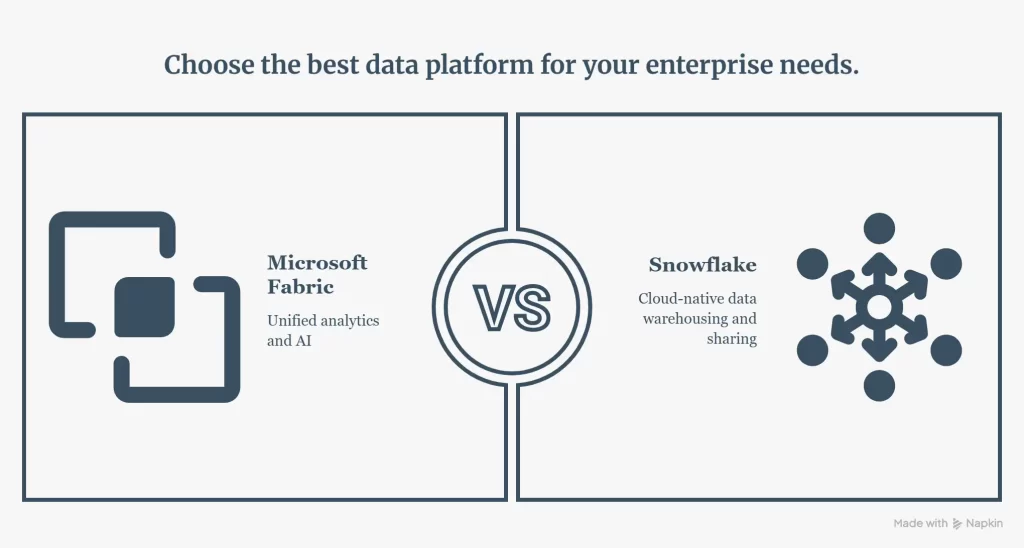
Microsoft Fabric and Snowflake offer different approaches to modern data platforms. The comparison below highlights their key differences across architecture, analytics, AI, scalability, deployment, and pricing.
| Feature | Microsoft Fabric | Snowflake |
| Primary focus | Unified analytics platform | Cloud-native data platform |
| Architecture | Integrated SaaS platform | Multi-cluster shared data architecture |
| Storage | OneLake | Cloud object storage |
| Business Intelligence | Native Power BI | Third-party BI tools |
| Data Engineering | Built-in | Supported |
| Data Warehouse | Built-in | Core capability |
| AI | Microsoft Copilot, Azure AI | Cortex AI, Document AI |
| Data Sharing | Supported | Industry-leading |
| Multi-cloud | Azure-focused | AWS, Azure, GCP |
| Administration | Minimal | Minimal |
| Best for | Microsoft-centric enterprises | Multi-cloud enterprises |
| Pricing | Capacity-based | Consumption-based |
If your priorities lean toward a unified platform and deeper Microsoft ecosystem integration, Microsoft Fabric may be the better fit.
When to Choose Microsoft Fabric
Microsoft Fabric is often the better choice if your organization:
- Uses Microsoft Azure extensively
- Relies on Microsoft 365 and Power BI
- Wants a unified analytics platform
- Prefers simplified licensing
- Wants built-in governance
- Needs faster deployment with fewer integration efforts
- Plans to leverage Microsoft’s Copilot ecosystem
It is particularly well suited for organizations seeking to consolidate fragmented analytics tools into a single modern platform.
If flexibility across cloud providers and independent workload scaling are higher priorities, Snowflake may be the stronger option.
When to Choose Snowflake
Snowflake may be the better choice if your organization:
- Operates across multiple cloud providers
- Requires enterprise-scale data sharing
- Has highly variable compute workloads
- Processes petabyte-scale datasets
- Wants independent compute scaling
- Is building AI applications on a cloud-agnostic platform
- Needs maximum workload isolation
Snowflake’s flexibility and scalability can be particularly valuable when you need to support complex data environments, varied workloads, and multi-cloud requirements.
Microsoft Fabric vs Snowflake: Which Data Platform Is Right for You?
There is no universal winner because both platforms excel in different scenarios.
Choose Microsoft Fabric if you prioritize:
- Unified analytics
- Native Power BI integration
- Simplified architecture
- Microsoft ecosystem alignment
- Faster implementation
Choose Snowflake if you prioritize:
- Multi-cloud flexibility
- Independent workload scaling
- Enterprise data sharing
- Cloud portability
- High-performance analytics
For many large enterprises, the decision is not solely based on technology. Factors such as governance, migration complexity, licensing strategy, skills availability, AI roadmap, and long-term total cost of ownership are equally important.
A well-planned assessment helps ensure the chosen platform aligns with both current operational needs and future business objectives.
Read: A Guide to AI in AP Automation: What It Is and How It Works
Seamless Data Modernization with Data Semantics
Selecting the right data platform is only the first step. The real value comes from designing, implementing, and optimizing a modern data architecture that delivers trusted insights, scales with business growth, and supports AI-driven innovation.
At Data Semantics, we help enterprises modernize their data ecosystem using both Microsoft Fabric and Snowflake. Our consultants work closely with your business and technology teams to build secure, scalable, and future-ready data platforms tailored to your strategic goals.
Our Microsoft Fabric services include:
- Microsoft Fabric strategy and roadmap
- End-to-end implementation
- OneLake architecture design
- Data warehouse modernization
- Power BI integration
- Governance and security
- Data migration and optimization
- AI and Copilot enablement
Our Snowflake services include:
- Snowflake architecture and deployment
- Cloud data warehouse modernization
- Legacy data migration
- ELT and data pipeline development
- Performance optimization
- Data governance and security
- Cost optimization
- AI-ready data platform implementation
Whether you’re evaluating Microsoft Fabric, migrating from legacy platforms, expanding your Snowflake environment, or planning an enterprise-wide data modernization initiative, our experts can help you accelerate time to value while minimizing risk.
Ready to modernize your data platform?
Discuss your business goals and discover whether Microsoft Fabric, Snowflake, or a hybrid architecture is the right fit for your organization.
FAQs
- Is Microsoft Fabric replacing Azure Synapse Analytics?
Microsoft Fabric builds upon many capabilities previously available in Azure Synapse Analytics by providing a more unified SaaS experience. While Synapse continues to be supported, Microsoft is positioning Fabric as its strategic analytics platform for future innovation.
- Snowflake only a data warehouse?
No. Snowflake has evolved into a comprehensive cloud data platform that supports data engineering, data lakes, AI, machine learning, secure data sharing, application development, and real-time analytics in addition to enterprise data warehousing.
- Which platform is more cost-effective?
It depends on your workload. Microsoft Fabric uses a capacity-based pricing model that can be advantageous for organizations standardizing on Microsoft technologies. Snowflake follows a consumption-based pricing model, allowing compute resources to scale independently, which can be beneficial for variable workloads when managed effectively.