If you look at any industry, it has been formed into the current shape because of revolutionary data science technology. But although the term may ring as a technical jargon, data engineering can simply be defined as the practice of designing and creating systems for gathering, storing and analyzing data at scale.
But beyond this terminology, how much do you understand about it, what does it mean for your business, what does a data engineer do, and what is the difference between data engineering, science and analysis. This guide explains all these questions. Read on!
Table of Contents
What is Data Engineering?

Data engineering is the act of collecting, storing, translating, and validating data. It is a broad field that plays a key role in the day-to-day activities of every industry. In short, it’s the act of making raw data into usable data.
Businesses collect massive data which need the right people and technology to ensure it is in a usable condition when it reaches data scientists and analysts. These teams work together to turn it into insight.
Without data engineering, the cleanest data from around the world sits in data silos (isolated collections of data trapped between departments, systems and units), not able to be used by AI models, analysts, scientists and business systems.
What does a data engineer do?
Data engineers work in diverse settings, building pipelines that automatically fetches data from source systems like customer databases, website analytics, and point-of-sales systems, to centralized platforms like cloud data warehouses. They collect, manage, and convert raw data into usable information by creating a structured dataset for data analysts and business analysts.
Their objective is to make sure the data is accurate, accessible, and timely, and its core goal is to make data accessible for your business to evaluate, optimize and enhance its performance.
Which data tools do data engineers use?
Data engineers need to be skilled and proficient with multiple tools and technologies to optimize and maintain data storage and quality across your organization. These are some of the common and important tools they use:
1. Data pipeline formats
Data pipeline formats –
When they build a pipeline, they automate the data integration process with scripts, which are lines of code that conduct redundant tasks. As per business needs, data engineers construct the pipeline in one of these formats – ETL or ELT.
- ETL: It stands for Extract, Transform, Load. ETL pipelines are automated data processing workflow that collects raw data from many sources, converts it into structured format by scripts, and loads into a central destination (data warehouse) for analytics, reporting and business intelligence.
ETL platforms: Stitch, Xplenty, Informatica, IBM DataStage and Talend
- ELT: It stands for Extract, Load, Transform. ELT workflows extract and load the raw data directly into the warehouse/data lake, and it executes transformations inside the warehouse itself. This collected data is later formatted and processed on specific business needs, offering better flexibility than conventional ETL pipelines.
ELT platforms: Stitch, Alooma, Fivetran, Airbyte, Talend, Xplenty
If you want to learn more about ELT and ETL, read this blog.
2. Storage solutions
- Cloud platforms: Give scalable infrastructure and managed services to store, process, and manage data workloads in the cloud.
- Relational databases: Store structured data in tables with predefined schemas. This is ideal for transactional applications and structured querying.
- NoSQL databases: Store semi-structured or unstructured data with flexible schemas, enabling high scalability and performance for diverse data types.
- Data warehouses: Centralized repositories optimized for storing and analyzing large volumes of structured data for business intelligence and reporting.
- Data lakes/lakehouses: Store raw structured, semi-structured, and unstructured data at scale, supporting analytics, data science and machine learning workloads.
3. Programming languages
- SQL: Query, manage, and transform data stored in databases and data warehouses
- Python: Build data pipelines, automate workflows and perform data processing
- Scala: Develop high-performance big data applications, especially with Apache Spark
- Java: Build scalable data processing systems and enterprise-grade data applications
Data Engineering Use Cases
Let’s look some of the real-word day-to-day applications of data engineering:
1. Financial services – fraud detection and risk management
Data engineering helps banks and financial institutions process large volumes of transaction data quickly, making it easier to detect suspicious activities and prevent fraud. It also provides accurate and updated information that helps your risk management team monitor financial frauds and make informed decisions.
2. E-commerce – personalization and inventory
Data engineering helps you understand customer preferences and recommend relevant products based on browsing and purchase behavior. The product recommendations your customers see after browsing are powered by systems that analyze their activity and deliver relevant suggestions. It also helps you track demand and inventory levels, ensuring your products are available when customers want to buy them.
3. Healthcare – unified patient data
Patient data lives across hospitals, labs, and specialist systems that rarely talk to each other. Data engineering ingests and normalizes records across providers, creating a holistic view that supports predictive analytics, better care coordination and early identification of at-risk populations.
4. Manufacturing and IoT – predictive maintenance
On a factory floor, an unplanned equipment failure can cost hundreds of thousands of lost productions. Data engineering continuously collects sensor and machine data, creating anomaly detection systems to flag issues before they become failures, shifting maintenance from reactive to predictive.
5. Retail – customer 360 and demand forecasting
Data engineering helps you bring customer data from purchase history, browsing behavior and in-store activity from your online and offline channels, creating a unified view of customer profile. It also helps you forecast demand more accurately, ensuring shelves remain stocked while reducing excess inventory and markdowns.
6. Media and entertainment – content recommendations
When a viewer finishes an episode and the next one auto-plays perfectly, that’s a recommendation engine working on data that was processed moments ago. Data engineering maintains the real-time pipelines that capture viewing behavior, update user profiles, and keep recommendation systems updated, directly driving engagement and retention.
Read: 15 Habits of Highly Effective Data Scientists
Data Engineering Lifecycle: How Does It Work?
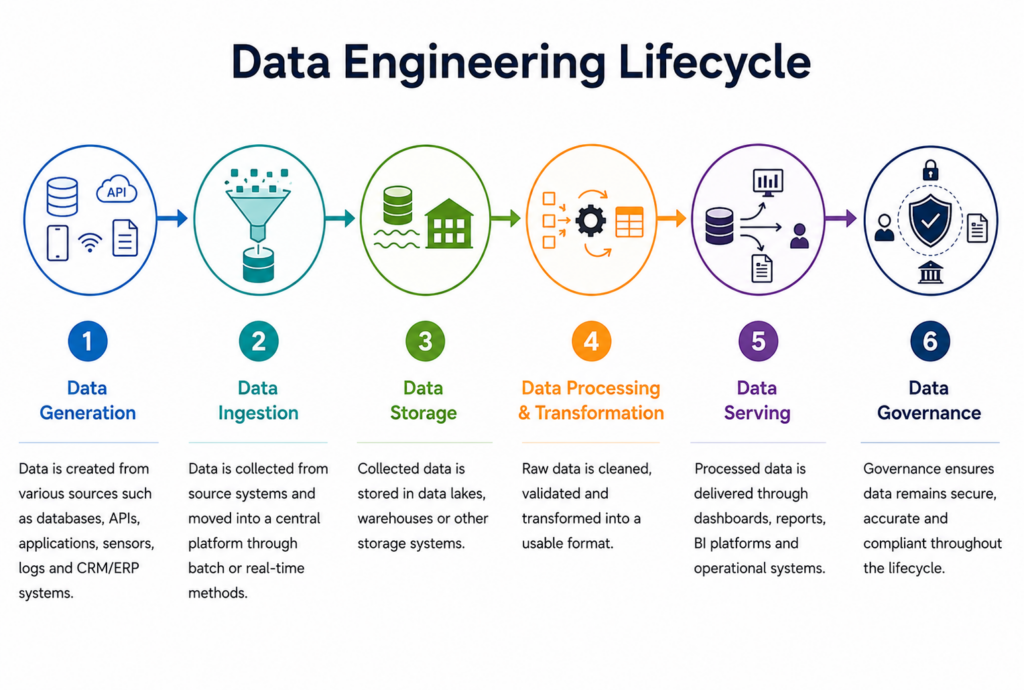
Data doesn’t become useful at the moment it’s created. It moves through a series of structured stages, from raw source to trusted insight and data engineering is what makes that journey reliable, consistent, and scalable. Here’s how each stage works in practice:
- Data generation: Data is created from various sources such as databases, APIs, applications, sensors, logs and CRM/ERP systems. Data engineers assess the quality, structure and reliability of this data before it enters the pipeline.
- Data ingestion: Data is collected from source systems and moved into a central platform through batch or real-time methods. This stage ensures data is captured accurately, validated and routed to the right destination.
- Data storage: Collected data is stored in data lakes, warehouses or other storage systems. Proper storage ensures scalability, accessibility and long-term reliability.
- Data processing and transformation: Raw data is cleaned, validated and transformed into a usable format. This helps create consistent, reliable data for reporting, analytics and machine learning.
- Data serving: Processed data is delivered through dashboards, reports, business intelligence platforms and operational systems. This ensures the right information is available to the right users when needed.
- Data governance: Governance ensures data remains secure, accurate and compliant throughout its lifecycle. It also helps maintain data quality, access controls and regulatory compliance.
Data Engineering vs. Data Analysis vs. Data Science: What’s the Difference?
While these disciplines often work together, each serves a different purpose in helping you turn data into business value.
- Data engineering builds the foundation by focusing on collecting, integrating, storing and preparing data, so it is reliable, accessible and ready for use across the organization.
- Data analysis helps you understand what has happened and why. It focuses on examining data, identifying trends, creating reports and dashboards, and supporting day-to-day business decisions.
- Data science helps you predict what may happen next. It uses statistical models and machine learning to forecast outcomes, identify opportunities and support more advanced decision-making.
Final Thoughts
Data engineering plays a critical role in helping your business turn raw data into reliable, usable information for analytics, AI and business decision-making. From building data pipelines to maintaining data quality and governance, it provides the foundation that modern data-driven organizations depend on.
As data volumes continue to grow, having the right data engineering processes is important for streamlining accuracy, accessibility and scalability. This is especially true during ERP migrations, system upgrades and transformation initiatives, where data quality can directly impact business outcomes.
Solutions like Data Prep 360™ help you improve data readiness, validate and reconcile critical data and reduce migration risks before go-live.
Book a consultation to see how Data Prep 360™ can support your next transformation project.
FAQs
- What are the 4 types of data science?
The four main types of data science are descriptive, diagnostic, predictive, and prescriptive analytics. Together, they help you understand what happened, why it happened, what is likely to happen next, and what actions you should take.
- What is data engineering in simple terms?
Data engineering is the process of collecting, organizing, and preparing data so it can be used for reporting, analytics, and AI initiatives. It helps you with reliable, accessible, and high-quality data to support your business decisions.
- What skills are required for a data engineer?
Data engineers need skills in data integration, database management, programming, cloud platforms, and data architecture. They also require problem-solving abilities and an understanding of how data supports business operations and decision-making.