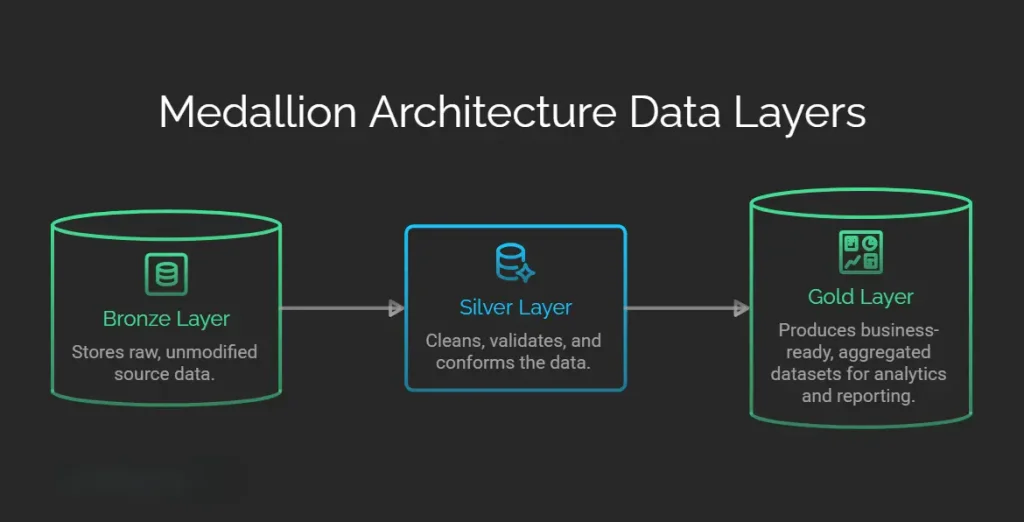
| TL;DR A medallion architecture is a data design pattern that organizes a lakehouse into three progressive quality layers: Bronze, Silver, and Gold. Bronze stores raw, unmodified source data. Silver cleans, validates, and conforms it. Gold produces business-ready, aggregated datasets for analytics and reporting. Data improves in structure and quality as it moves through each layer. Originally defined by Databricks as a best practice for the Lakehouse, the pattern has been adopted across Snowflake, Microsoft Fabric, and other modern data platforms as the standard approach to data layering in enterprise data estates. |
Most enterprise data teams understand the Bronze-Silver-Gold model and many have already built it. And an increasing number are running into the same problem: their AI initiatives are deployed on top of a well-structured medallion data architecture, and the AI is still producing inconsistent, unreliable results.
The architecture is good. The problem is a gap between what the three-layer model was designed to do, deliver clean, governed data for human analysts, and what AI systems, agents, and large language models actually require. The latter needs not just clean data, but semantically governed data. Data whose concepts, metrics, and relationships are formally defined and machine-readable, not just well-formatted and historically consistent.
This guide explains what a medallion architecture is, how it is implemented on Databricks, Snowflake, and Microsoft Fabric, what its limits are for enterprise AI workloads, and what a mature lakehouse design looks like when those limits are addressed.

What Is a Medallion Architecture?
A medallion architecture, also called a multi-hop architecture or data medallion architecture, is a layered data layering pattern for organizing a lakehouse. The term was defined and popularized by Databricks and is now the de facto standard for lakehouse design across the major cloud data platforms.
Its defining principle is progressive data refinement. Raw data enters at the bottom layer and gains quality, structure, and business context as it moves up. Each layer serves a distinct set of consumers and purposes.
| Layer | Also Called | What It Holds | Primary Consumers | Quality Standard |
| Bronze | Raw / Landing | Source data as ingested, unchanged schema, full history, appended incrementally. Metadata added: load timestamp, source system, process ID. | Data pipelines only (feeds Silver) | Raw fidelity, preserve everything, validate nothing beyond receipt |
| Silver | Cleansed / Conformed / Validated | Cleaned, deduplicated, normalized data. Schema enforced. Nulls handled. Late data resolved. Enterprise entity views: customers, products, transactions. | Data engineers, analysts, data scientists | Queryable and trustworthy for analysis |
| Gold | Enriched / Curated / Consumption | Aggregated, business-aligned datasets. Dimensional models (Kimball star schema). Pre-aggregated metrics. BI-ready, low-join, read-optimized. | Business analysts, BI developers, executives, operational teams, ML models | Report-ready; business logic applied |
The bronze silver gold layers model is effective for what it was designed to do: prevent data swamps by enforcing progressive quality standards, support reprocessing from raw data when transformations fail, and separate the concerns of data ingestion, data cleaning, and data consumption. For reporting-era analytics workloads, it is a proven data layering approach.
How the Medallion Architecture Is Implemented Across Major Platforms
The pattern is consistent, Bronze, Silver, Gold, but each major cloud data platform implements it with platform-specific tooling. Here is what that looks like in practice.
Databricks Medallion Architecture
Databricks coined the term and their implementation is the reference. Databricks medallion architecture is built on Delta Lake tables, with Bronze, Silver, and Gold organized as schemas within a Unity Catalog structure (for example, `ops.bronze`, `ops.silver`, `ops.gold`). Spark Declarative Pipelines build the layer transitions from minimal code, with Streaming Tables for append-only sources and Materialized Views for Gold aggregations.
The medallion architecture Databricks documentation recommends keeping Bronze append-only and append-only: never write directly from ingestion to Silver, since source schema changes can silently corrupt the Silver layer. Gold tables should be pre-aggregated with materialized views for the metrics accessed most frequently, and tuned for read performance since they are queried far more heavily than the lower layers.
Unity Catalog provides lineage tracking across all three layers: table and column lineage is recorded automatically, and change history supports audit and regulatory traceability requirements.
Snowflake Medallion Architecture
In a Snowflake medallion architecture, the three layers are typically implemented as separate databases or schemas within the same Snowflake account: `RAW` (Bronze), `ANALYTICS` (Silver), and `REPORTING` (Gold). Data flows through Snowpipe for near-real-time Bronze ingestion, with dbt or Snowflake Tasks handling Silver transformation and Gold aggregation. Dynamic Tables, introduced in Snowflake in 2024, provide incremental refresh for Gold-layer views without requiring manual scheduling.
The medallion architecture Snowflake approach leverages Snowflake’s separation of storage and compute: Bronze data sits in cheap object storage and is queried rarely; Gold tables are queried constantly and benefit from dedicated virtual warehouses sized and auto-suspended for their workload pattern. Snowflake’s data sharing capabilities allow Gold-layer tables to be shared with downstream consumers in other accounts without data movement.
Fabric Medallion Architecture
Microsoft Fabric implements the fabric medallion architecture pattern through its Lakehouse and Warehouse components, both built on OneLake, a single unified storage layer that sits beneath all Fabric workloads. Bronze data lands in a Lakehouse’s Files section as raw files; Silver and Gold are promoted to Delta tables in the Lakehouse’s Tables section or moved to a Fabric Data Warehouse for SQL-first teams.
The practical choice at the Gold layer: a Lakehouse suits Power BI DirectLake mode, where reports read Delta files directly without data duplication. A Fabric Data Warehouse suits teams running complex T-SQL stored procedures. Cross-engine access means Fabric Data Warehouse T-SQL can query Lakehouse tables and vice versa, without physical data movement, useful for mixed workloads where some Gold consumers want Python and others want SQL.
Microsoft Purview provides lineage and governance across the fabric medallion architecture, tracking data movement from Bronze ingestion through Gold consumption and into Power BI reports.
Why Gold Is Not the Finish Line for Enterprise AI
Here is the problem the medallion data architecture was not designed to solve: Gold-layer data was built for people. Human analysts bring contextual judgment to it, they know that ‘revenue’ in one report means recognized revenue and in another means booked revenue, and they reconcile the difference. AI systems do not bring that judgment. They ingest whatever definition they encounter first and apply it consistently, even when it is wrong for the query context.
The data layering model enforces data quality, correctness, completeness, consistency at the record level. It does not enforce semantic consistency: shared, formal definitions of what concepts mean and how metrics are calculated. That gap is what creates the ‘confidently wrong AI’ pattern that engineering teams are encountering when they deploy LLMs and agents over their lakehouse design.
Four specific failure modes in AI workloads built on Gold-layer data alone
1. Metric inconsistency across domains. Gold tables built for different business units frequently define the same metric differently: Finance calculates ‘margin’ one way, Sales calculates it another. For human analysts, this is a known issue they navigate by context. For an AI agent summarizing performance across both domains, it produces contradictory outputs with no indication that anything is wrong.
2. No formal entity resolution. ‘Customer’ in the CRM Gold table and ‘account’ in the financial Gold table may refer to the same real-world entity, but the connection is in an analyst’s head, not in the data architecture. AI traversing both tables cannot know they are the same entity without an explicit entity resolution layer.
3. Governance applied too late. When lineage, ownership, and certification are added after the architecture is built, they describe what exists, they do not govern what is consumed. AI agents operating on data where ownership and quality certification are informal metadata fields that someone updated six months ago are operating without reliable data trust signals.
4. Scale amplifies errors. When a human analyst encounters a suspicious number, they pause and investigate. When an AI agent encounters the same number in an automated pipeline, it acts on it. Poor-quality data in the medallion architecture was a reporting inconvenience in the analytics era. In the AI era, it becomes a systematic source of incorrect automated decisions.
What Enterprise-Ready Looks Like: Adding the Semantic Layer on Top of Gold
The answer is not to replace the medallion data architecture, it is to complete it. The three layers handle data quality: Bronze preserves fidelity, Silver enforces structural correctness, Gold produces business-aligned datasets. What is needed above Gold is a layer that handles semantic governance: formal, machine-readable definitions of what the data means.
This layer, sometimes called a Platinum layer, a semantic layer, or an AI-readiness layer, adds four capabilities that the standard data medallion architecture does not include:
- An ontology, a formal, shared vocabulary that defines entity types (‘customer,’ ‘transaction,’ ‘product’), their properties, and the rules governing their relationships
- A metrics layer, governed, versioned definitions of every business metric, centrally managed so that ‘revenue,’ ‘margin,’ and ‘churn’ mean the same thing whether the query comes from a BI tool, an AI agent, or an embedded application
- Entity resolution, explicit mappings between records in different Gold tables that represent the same real-world entity, so AI can traverse them correctly
- Trust signals, lineage, ownership, certification, and quality scores attached to every dataset and metric definition, so AI systems and downstream consumers can assess data quality before acting on it
The key design principle, as WhereScape’s research on medallion AI readiness notes, is that semantic context is not an afterthought applied to Gold, it must be designed in at multiple layers. Access control belongs in Silver, defined once for enterprise-wide rules. Business definitions that legitimately vary by consumer (revenue at deal close vs. revenue at payment clearing) belong in Gold, explicitly documented and agreed. The semantic layer above Gold references both.
| The Data Semantics Approach Data Semantics builds the semantic layer, ontology, context graph, and AI-readiness layer inside the platforms enterprises already operate , Microsoft Fabric, Databricks, or Snowflake. The medallion architecture handles Bronze, Silver, and Gold. Data Semantics adds the governed semantic layer on top: AI-assisted discovery maps your Gold data to formal ontology definitions; business owners approve every definition. The result is a lakehouse that is not just clean but semantically ready for AI agents, LLMs, and production AI workloads. |
Medallion Architecture Best Practices for Enterprise Implementation
Whether building from scratch or maturing an existing medallion architecture, these principles consistently differentiate programs that deliver sustained value from those that accumulate technical debt:
Bronze: preserve everything, validate receipt only
Bronze is not a staging area, it is a permanent audit layer. Store source data in its original format, schema, and resolution. Add load metadata (timestamp, source system ID, process ID) but do not alter source fields. Store most fields as string, VARIANT, or binary to guard against source schema changes breaking the ingestion layer. The rule: Bronze must be replayable. If Silver or Gold is corrupted, you should be able to rebuild it entirely from Bronze without re-reading the source system.
Silver: define enterprise rules once
The temptation in Silver is to build it domain by domain, with each team applying their own cleaning rules. This recreates the silos the architecture was meant to remove. Enterprise-wide rules, entity resolution, standard date formatting, null handling policies, belong in Silver and should be defined centrally, applied consistently. Silver is also where access control is most valuable: define row-level and column-level security at Silver so it propagates automatically to Gold rather than being reimplemented in every downstream table.
Gold: build for query patterns, not for all possible queries
Gold tables built to accommodate every possible question become bloated and slow. Build Gold for the specific consumption patterns that have been agreed: the BI dashboard that runs every morning, the ML pipeline that trains weekly, the operational report that feeds the sales team. Pre-aggregate metrics that are recomputed identically by multiple consumers. Use materialized views for the highest-frequency queries. Create multiple Gold layers for genuinely distinct business domains rather than trying to serve all consumers from one universal Gold table.
Governance by design, not by documentation
Lineage, ownership, and quality certification must be built into the data medallion architecture from the start, not added as metadata fields after the fact. In Databricks, Unity Catalog records table and column lineage automatically. In Fabric, Microsoft Purview tracks data movement end-to-end. In Snowflake, Governance policies and Access History provide audit trails. The governance layer is only as good as its integration with the platform’s native capabilities: use them rather than building parallel documentation that drifts from the actual data state.
Plan for AI consumption from the Silver layer up
If AI workloads are on the roadmap, and in most enterprises they are, plan the semantic layer before Gold is finalized, not after. The Gold model you build for human BI consumers will differ from the Gold model that works best as the foundation for a semantic layer. Specifically: avoid implicit business logic embedded in Gold table names or column names that an AI cannot read. Document business definitions as explicit metadata on every Gold table, not as institutional knowledge in analyst heads.
| Talk to Data Semantics Data Semantics builds and matures medallion data architectures inside Microsoft Fabric, Databricks, and Snowflake, and adds the semantic layer, ontology, and AI-readiness capabilities that the standard three-layer model does not include. If your data platform program is at the Gold layer and your AI initiatives are running into governance and consistency problems, the conversation starts here. Talk to Data Semantics about your data platform → |
Frequently Asked Questions
What is a medallion architecture in data engineering?
A medallion architecture is a data design pattern that organizes a lakehouse into three progressive quality layers: Bronze (raw source data), Silver (cleaned, validated, conformed data), and Gold (aggregated, business-ready data for analytics and reporting). Data improves in structure and quality as it moves through each layer. The pattern was defined by Databricks as a best practice for lakehouse design and is now standard across Snowflake, Microsoft Fabric, and other modern data platforms.
What is the difference between Bronze, Silver, and Gold layers?
Bronze stores raw, unmodified source data as it arrives, appended incrementally with metadata but no transformation. Silver cleans, deduplicates, validates, and normalizes Bronze data to produce enterprise entity views, customers, products, transactions, that are queryable and trustworthy for analysis. Gold aggregates Silver data into business-aligned, read-optimized datasets using dimensional models like star schemas, pre-computed for the specific analytics and reporting workloads the organization runs. Each layer serves a distinct set of consumers: Bronze feeds pipelines, Silver feeds engineers and analysts, Gold feeds business users and AI models.
How does Databricks implement the medallion architecture?
The Databricks medallion architecture uses Delta Lake tables organised as schemas within Unity Catalog (ops.bronze, ops.silver, ops.gold). Spark Declarative Pipelines build layer transitions with Streaming Tables for append-only sources and Materialized Views for Gold aggregations. Unity Catalog records table and column lineage automatically. Databricks recommends keeping Bronze append-only and not writing directly from ingestion to Silver, since source schema changes can corrupt the Silver layer.
How is a Snowflake medallion architecture set up?
In a Snowflake medallion architecture, the three layers are typically implemented as separate databases or schemas within the same account. Snowpipe handles near-real-time Bronze ingestion. dbt or Snowflake Tasks manage Silver transformation and Gold aggregation. Dynamic Tables (available since 2024) provide incremental refresh for Gold views without manual scheduling. Snowflake’s separation of storage and compute means Bronze data sits in cheap object storage queried rarely, while Gold tables use dedicated virtual warehouses sized for their query load.
What is a Fabric medallion architecture?
Microsoft Fabric implements the medallion architecture using its Lakehouse and Data Warehouse components, both built on OneLake, a single unified storage layer. Bronze data lands as raw files in a Lakehouse’s Files section. Silver and Gold are promoted to Delta tables in the Lakehouse’s Tables section or moved to a Fabric Data Warehouse for T-SQL workloads. Power BI DirectLake mode allows reports to read Gold-layer Delta files directly without duplication. Microsoft Purview provides lineage and governance across all layers.
Is a medallion architecture enough for enterprise AI?
A well-built medallion architecture handles data quality: it ensures data is clean, consistent, and queryable. It does not by itself handle semantic governance: formal, machine-readable definitions of what metrics and entities mean, entity resolution across domains, or trust signals that AI agents can evaluate before acting on data. For AI workloads, LLMs, agentic systems, embedded AI in operational applications, a semantic layer built on top of the Gold layer is needed to give AI systems the governed context they require to reason accurately and consistently over enterprise data.