
Table of Contents
TL;DR Summary
- Agentic AI is AI that can plan, reason, use tools, and take multi-step actions toward a goal with minimal human input. Unlike generative AI, which primarily creates content in response to prompts, agentic AI can execute tasks and adapt its approach based on the results.
- How it works: Agentic AI combines large language models with perception, reasoning and planning, tool use, memory, and reflection. These capabilities work together in a continuous loop, allowing the system to evaluate results and adjust its actions.
- What it can do: Agentic AI can automate complex workflows across customer service, IT operations, supply chain, software development, financial operations, and sales.
- Business benefits: When applied to the right workflows, agentic AI can reduce manual work, speed up decision-making, improve consistency, and free teams to focus on higher-value activities.
- What enterprises need to scale it: Start with a focused, high-friction workflow, ensure the underlying data is reliable and accessible, establish clear guardrails, measure outcomes, and retain human oversight for high-stakes decisions.
- The key risk: More than 40% of agentic AI projects are projected to be canceled by 2027 because of escalating costs, unclear business value, or inadequate risk controls, according to Gartner. Strong data foundations, governance, and measurable business outcomes are therefore critical to successful adoption.
In a product roadmap meeting, you may have heard the term “agentic AI” repeatedly. For B2B SaaS leaders, CTOs, CDOs, and IT directors, the real question is simple: what is agentic AI going to do for your business, and is it worth the investment now?
You already know generative AI can draft an email or summarize a report. What many teams have not fully grasped is that agentic AI goes further: it does not just respond, it acts, planning multi-step tasks, calling the right tools, and course-correcting without someone hovering over it.
In this guide, you will learn what agentic AI means, how it works, where it delivers business value, real agentic AI examples, and the best practices that separate a successful rollout from a stalled pilot.
What is Agentic AI
Agentic AI is a class of artificial intelligence systems built to pursue goals autonomously. Instead of waiting for a prompt and returning a single response, an agentic AI system breaks a goal into steps, decides which actions to take, uses external tools or data sources, evaluates the results, and adjusts its approach until the task is complete.
Think of it this way: if you ask a generative AI chatbot to “find the best vendor contract terms,” it summarizes what it already knows. An agentic AI system can search your contract repository, compare terms across vendors, flag the outliers, and route a recommendation for approval, all without a second prompt.
Agentic AI vs. generative AI vs. AI agents
You will run into all three terms constantly, so it helps to separate them clearly:
- Generative AI: Creates new content, such as text, images, or code, in response to a prompt. It is reactive by nature and has no persistent goal beyond the current request.
- An AI agent: Is typically a single, task-specific tool built on top of a generative model, designed to complete one job, such as answering support tickets or scheduling meetings.
- Agentic AI: Describes the broader system-level capability, where multiple agents, reasoning loops, memory, and tool access work together toward a larger, often multi-step business objective.
In short, an AI agent is a component. Agentic AI is the architecture and behavior that makes autonomous, goal-driven action possible. If you want to see how this compares with content-generation use cases, check out our guide on generative AI for enterprises.
How Does Agentic AI Work?
Agentic AI systems generally rely on four mechanisms working in a continuous loop rather than a single input-output exchange.
Core mechanisms in the agentic loop
- Perception: The system gathers context from data sources, APIs, or live systems to understand the current state of a task.
- Reasoning and planning: A large language model breaks the goal into steps and decides the order of operations.
- Action through tool use: The agent calls external tools, APIs, or databases to execute steps, not just describe them.
- Memory and reflection: The system retains context across steps, checks its output against the goal, and revises its plan when something does not line up.
This loop is what lets agentic AI handle ambiguity. If an API call fails or data comes back unexpectedly, the system adapts and tries another path instead of simply stopping.
Many enterprise platforms also use Retrieval-Augmented Generation (RAG) to ground actions in your company’s actual data, and increasingly rely on standards like the Model Context Protocol (MCP) to connect agents to tools and data sources securely. Data Semantics’ Artificial Intelligence services help enterprises design this kind of connected, tool-aware AI architecture from the ground up.
Benefits of Agentic AI for Your Business
If you’re evaluating where to invest, the benefits of agentic AI tend to cluster around four areas.
- Reduced manual workload: Agentic AI handles multi-step, rules-based processes end to end, freeing your teams from repetitive coordination work like data entry or ticket triage.
- Faster decision cycles: Because agents can pull data, analyze it, and act in near real time, decisions that used to take days can happen in minutes.
- Improved accuracy at scale: Well-governed agentic systems apply consistent logic across thousands of transactions, reducing the variability of manual processes.
- Better resource allocation: When routine execution is automated, your highest-value people spend more time on judgment calls and strategy.
According to McKinsey’s State of Organizations 2026 report, 88% of organizations are now using AI in some form. Leaders also expect AI to deliver measurable business benefits, with 55% anticipating measurable productivity gains from building strong AI capabilities across their workforce, 48% expecting faster and broader access to information, and 47% anticipating a meaningful reduction in administrative work.
The gap is that most organizations are still applying AI to fragmented, individual use cases rather than redesigning entire workflows around agents. That gap is the opportunity: organizations that move from isolated pilots to end-to-end agentic workflows now can turn a well-executed rollout into a genuine competitive advantage.
Ready to see what this looks like for your workflows? Talk to an AI consultant from our team.
How to Integrate Agentic AI Into Your Business
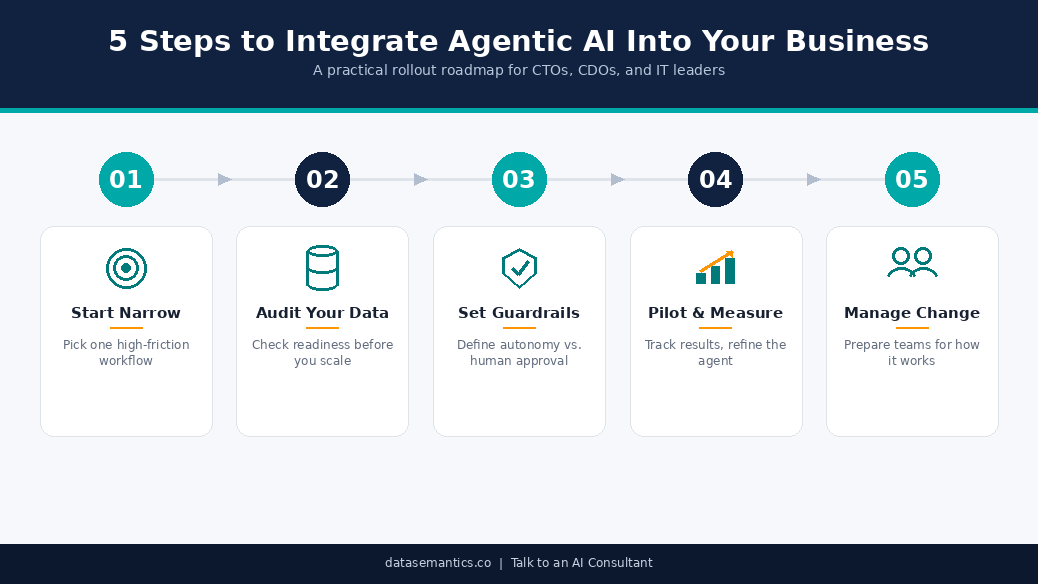
Rolling out agentic AI is less about the model you choose and more about the foundation you build under it. Work through these steps before deploying anything customer-facing or business-critical.
1. Start with a well-scoped, high-friction workflow
Choose a specific process, such as invoice reconciliation or tier-1 support triage, rather than trying to automate an entire department at once.
2. Audit your data readiness
Agentic AI is only as reliable as the data it can access. Siloed or inconsistently governed data can limit its effectiveness.
3. Define guardrails before capabilities
Set clear boundaries around what the agent can do autonomously and what requires human approval, especially for financial, legal, or customer-facing actions.
4. Pilot with a feedback loop
Track error rates and time saved, then use those insights to refine the agent’s decision boundaries.
5. Plan for change management
Make sure teams understand what the agent does, what it does not do, and when and how to intervene.
When your data is scattered across systems, our Advanced Analytics services can help you build the unified, trustworthy data layer an agentic AI rollout depends on, a step organizations often skip and later regret.
For organizations bringing invoice and AP workflows into that plan, our guide on AI in AP automation breaks down what it is and how it works in practice.
Real-World Examples of Agentic AI
Agentic AI is already at work across nearly every industry, wherever a workflow involves multiple decisions, several systems, and enough repetition to make full automation worthwhile. The examples below span core enterprise functions as well as more specialized domains, giving you a broader view of where agentic AI applications are proving out today.
Business and enterprise operations
- Supply chain orchestration: An agent continuously tracks inventory levels, forecasts demand shifts using live market signals, and places replenishment orders with suppliers automatically, closing the loop between forecasting and procurement.
- Talent acquisition: A recruiting agent can draft job postings, screen incoming resumes against role requirements, run first-round conversational interviews, and schedule next steps with shortlisted candidates, compressing a process that typically spans weeks.
Software development and IT
- Autonomous coding and debugging: Development agents can turn a ticket into a working solution, planning the approach, writing the code, running tests, fixing failures, and opening a pull request for human review.
- Legacy system modernization: Agentic AI can decompose complex, decades-old applications, such as monolithic COBOL systems, into modular components and help migrate them to modern infrastructure in a fraction of the time manual re-platforming would take.
- IT service management: Instead of routing every request to a queue, an agent can verify an employee’s identity, resolve common issues like password resets directly, and only escalate tickets that require specialized judgment.
- Incident response: When an outage or security event occurs, an agent can trigger rollback procedures, compile an incident report, and notify the right stakeholders, then support a deeper post-incident review to reduce the odds of recurrence.
Customer experience and marketing
- End-to-end support resolution: An agent handles a support request from intake to close, searching the knowledge base, taking action on the customer’s account when needed, and looping in a human agent only when a case falls outside its confidence threshold.
- Campaign management: Given a goal like “grow sales of a new product line,” a marketing agent can identify target segments, launch outreach, and continuously adjust the campaign based on performance data.
Specialized and emerging use cases
- Financial markets: Trading agents analyze live pricing and macroeconomic indicators to identify patterns and execute trades within predefined risk parameters.
- Autonomous mobility: Self-driving systems fuse GPS, lidar, and sensor data in real time to plan routes and respond to changing road conditions.
- Healthcare monitoring: Clinical agents can track patient vitals and lab results, flag changes that warrant a treatment adjustment, and surface relevant context to care teams before it becomes urgent.
- Cybersecurity: Security agents continuously watch network traffic, logs, and user behavior for anomalies that could signal malware, phishing, or unauthorized access, often catching threats faster than manual monitoring alone.
- Research and development: Agents can pull findings from published research, synthesize insights across sources, and propose next experiments, helping R&D teams move from question to hypothesis faster.
These agentic AI applications share a pattern: they succeed where the workflow is data-rich, rules-based enough to define guardrails, and repetitive enough that the ROI compounds quickly. Many of these use cases build on the same automation foundation as Robotic Process Automation, but with the added ability to reason and adapt rather than just follow fixed rules.
Challenges of Scaling Agentic AI
The gap between a promising pilot and a production-grade deployment is where most agentic AI projects stall. Watch for these common obstacles.
- Data fragmentation: Disconnected customer, financial, and operational data means agents cannot reason across systems reliably.
- Trust and explainability: Stakeholders and regulators want to know why an agent made a decision, so logging cannot be an afterthought.
- Cost and ROI uncertainty: Multi-step reasoning is more compute-intensive than a single generative AI response, so costs can climb fast without usage boundaries.
- Security and access control: Broad tool access means a broad attack surface, so permissions should be scoped as tightly as for a human employee.
- Talent and change readiness: Monitoring and auditing agentic systems requires a different skill set than traditional software maintenance.
Gartner projects that more than 40% of agentic AI projects will be canceled by 2027 due to escalating costs, unclear business value, or inadequate risk controls, according to Gartner. Organizations that get their data and governance in place early will be better positioned to avoid these pitfalls.
Best Practices of Agentic AI Success
As agentic AI moves into production, the focus shifts from getting the system running to keeping it reliable, accountable, and valuable over time. Keep these practices front and center:
- Govern for accountability, not just control. Define who owns each agent, who is accountable for its outcomes, and how issues are escalated. Governance should remain active throughout the agent’s lifecycle, not end at deployment.
Tip: Assign a clear business owner to every production agent and review its performance and access regularly. - Measure business impact, not just automation. An agent completing more tasks does not necessarily mean it is creating more value. Measure outcomes such as cost per transaction, resolution time, accuracy, customer satisfaction, or revenue impact.
Tip: Establish a small set of business KPIs before launch and use them as the basis for quarterly performance reviews. - Design for graceful failure. Agents will encounter incomplete information, conflicting inputs, unavailable tools, and situations they cannot resolve confidently. A reliable system should know when to stop rather than make a poor decision.
Tip: Define explicit failure states and escalation paths for situations where confidence, data quality, or system availability falls below an acceptable threshold. - Make decisions explainable. When an agent makes an important decision, teams should be able to understand what information influenced it and what actions followed. This is particularly important for audit, compliance, and customer-facing workflows.
Tip: Maintain an audit trail of key inputs, decisions, tool calls, and actions so issues can be traced without reconstructing the entire workflow. - Treat agents as continuously evolving systems. An agent’s performance can change as business rules, data, connected tools, and operating conditions change. Regular reviews help prevent gradual performance degradation from going unnoticed.
Tip: Schedule periodic agent reviews using production data, exception patterns, and user feedback to identify where the system needs to be updated.
Read: The Ultimate Guide to Data Platform Migration: Steps, Challenges & Best Practices
What’s Next for Agentic AI?
Expect three shifts over the next few years. Agents will move from single-task execution to coordinating with other agents in multi-agent, or “agent swarm,” architectures. Standards like MCP will make it easier for agents to connect securely across tools and vendors.
And enterprises will increasingly formalize their own internal governance practices, giving them structured, repeatable ways to monitor and control autonomous systems as they scale.
The organizations that get ahead will not be the ones with the flashiest demo. They will be the ones with the data foundation and governance model to let agentic AI run safely and reliably in production.
This is where Serina, Data Semantics’ end-to-end invoice automation platform, applies the principles discussed in this guide to accounts payable.
Meet Serina: The end-to-end invoice automation platform
Serina is an end-to-end invoice management and automation software, built to take your accounts payable team from invoice capture and approval routing to automated validation, reconciliation, and payment. It follows the same agentic pattern covered in this guide, applied to one of the highest-friction workflows in most finance organizations.
- Perceives: Captures incoming invoices from email, portals, and scanned documents automatically.
- Reasons: Validates line items, purchase orders, and approval rules against your policies.
- Acts: Routes exceptions, triggers approvals, and processes payments without manual handoffs.
- Adapts: Adjusts as your vendors, policies, and finance processes change over time.
Conclusion
Agentic AI marks a real shift from AI that talks to AI that does. It plans, decides, acts, and adapts, taking on workflows that generative AI alone was never built to handle. The benefits are significant, but they only materialize when you pair the technology with clean data, clear governance, and well-scoped use cases.
Start small, measure rigorously, and build your data foundation first. That is what separates the organizations successfully scaling agentic systems from the rest still stuck at the pilot stage.
Ready to move from pilot to production? Talk to an AI consultant right away.